

You are funding growth from revenue, not a venture check. Every dollar you spend on ads has to pull its weight. The problem is that the most popular cost-effective advertising channels are also the most crowded, which means they stopped being cost-effective two years ago.
Here is where bootstrapped teams should spend in 2026 to get real results without burning runway.
Where Most Bootstrapped Startups Waste Budget
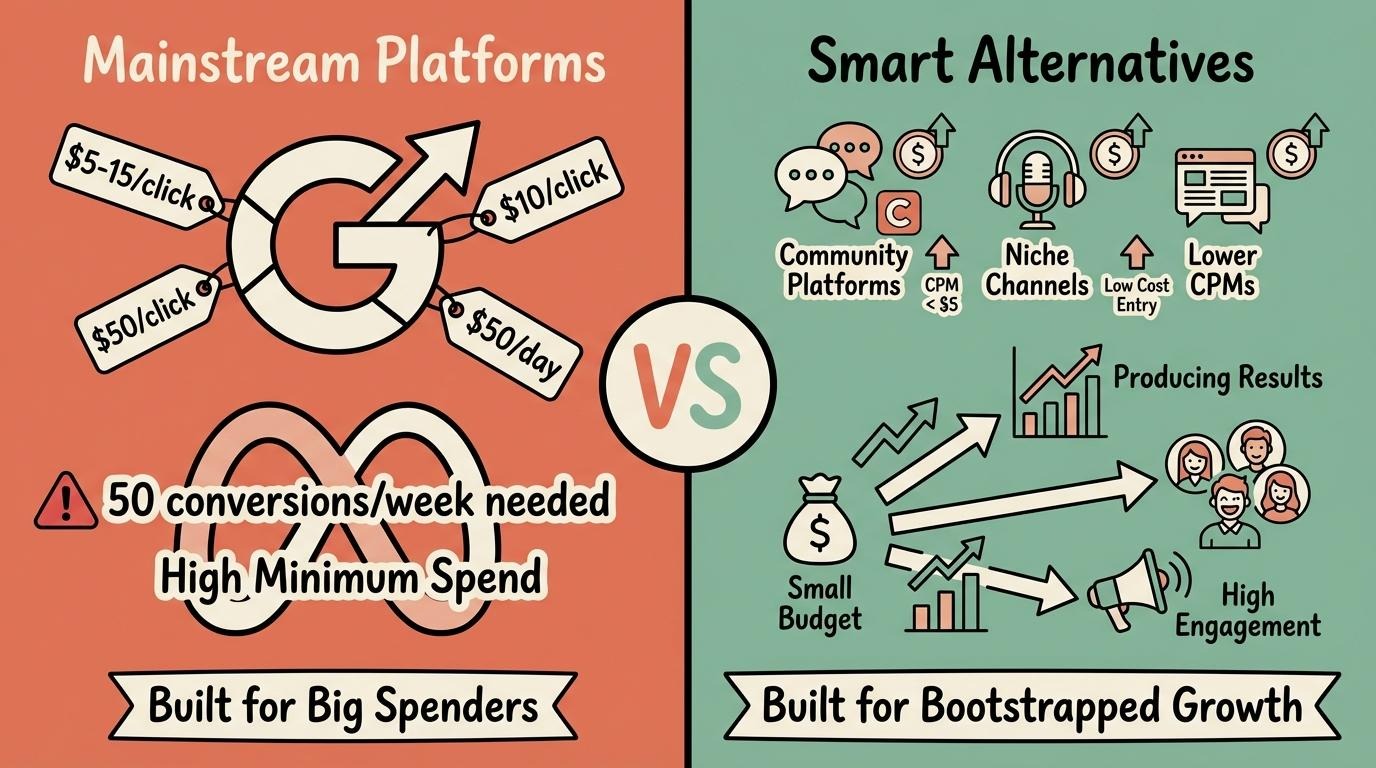
The instinct is to start with Google Ads. It makes sense on paper. High intent, keyword targeting, measurable results. In practice, competitive keywords cost $5-$15 per click in most SaaS and e-commerce categories. A bootstrapped startup spending $3,000 per month gets 200-600 clicks. That is barely enough data to optimize.
Meta is the next stop. Costs are lower, but the learning phase eats budget. Facebook’s algorithm needs 50 conversions per week per ad set to optimize properly. If your budget cannot support that volume, you are paying for the algorithm to learn without ever reaching peak performance.
Spending small budgets on platforms built for big spenders is the fastest way to conclude that paid ads do not work.
What Cost-Effective Channels Actually Look Like
Low CPM With High Relevance
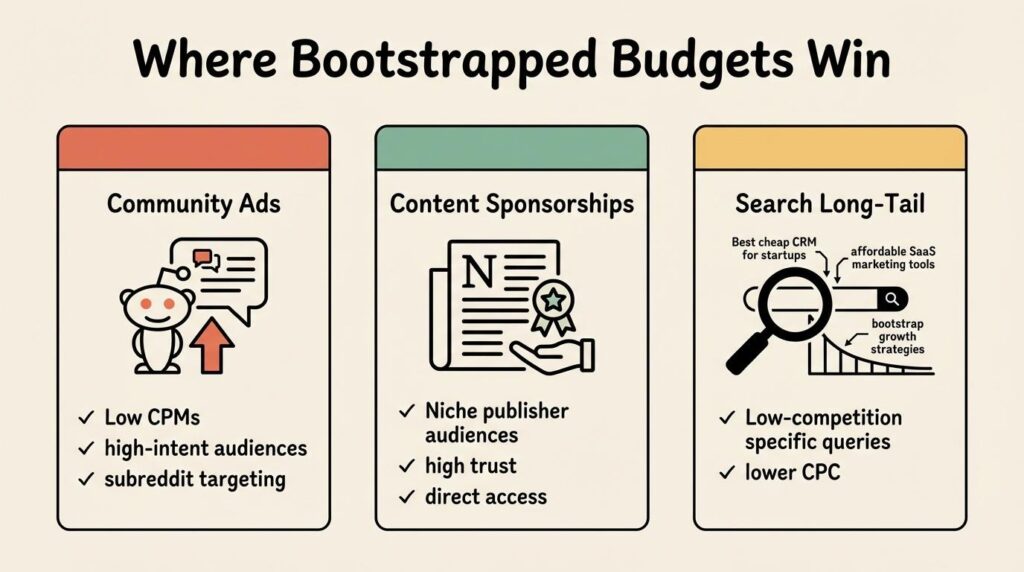
Cost per thousand impressions means nothing if the impressions reach the wrong people. A $2 CPM on a display network delivers eyeballs that scroll past. A $8 CPM on a niche community platform delivers people who care about your category. Effective CPM accounts for relevance, not just reach.
Small Minimum Spend Requirements
The best channels for bootstrapped teams let you test with $500-$2,000 per month and still generate enough data to make decisions. If a platform requires $10,000 per month before its targeting kicks in, it is built for funded companies.
Targeting by Intent or Interest
Demographic targeting spreads your budget across people who may or may not care. Interest-based targeting concentrates it on people already thinking about your problem. When you advertise on reddit, you pick specific subreddits where your audience already participates. That precision keeps waste low.
Native Ad Formats That Do Not Require a Design Team
Bootstrapped startups rarely have a designer on call. Channels that support text-based or simple image ads level the playing field. If a platform requires video production or carousel assets to compete, it favors teams with bigger creative budgets.
Fast Feedback Loops
You need to know within two weeks whether a channel has potential. Platforms with real-time reporting and small audience sizes give you signal quickly. Channels with 7-day attribution windows and delayed reporting slow your learning cycle.
Self-Serve Setup Without Sales Calls
If you have to book a demo with an ad rep before spending your first dollar, the platform is optimized for enterprise budgets. Self-serve platforms let you launch today and adjust tomorrow.
How to Stretch a Small Ad Budget Further
Pick one channel and own it before expanding. Spreading $3,000 across three platforms gives you $1,000 each. That is not enough to learn anything. Put the full budget behind one channel for 30 days.
Test messaging before scaling spend. Run five ad variants at $10-$20 per day each. After a week, kill the bottom three and shift budget to the top two. This costs less than running one untested ad at full budget.
Use organic content to validate paid angles. Post your ad messaging as organic content first. If a forum post or tweet gets engagement, turn that angle into a paid ad. Free validation before you spend.
Target small, specific audiences. A subreddit with 50,000 members who match your ICP is more valuable than a Meta audience of 2 million loosely defined users. When you advertise on reddit or use similar community platforms, smaller audiences often mean higher conversion rates at lower costs.
Retarget your website visitors on the cheapest platform available. Retargeting audiences are small by nature. You do not need a premium platform to serve ads to 500 warm visitors. Find the cheapest retargeting option and use it.
The Bootstrapper’s Advantage
Funded competitors outspend you on Google and Meta. That is a fight you lose. But they also move slowly. Big budgets come with big approval processes, long planning cycles, and risk-averse creative.
You can test a new channel in a day. You can write an ad in ten minutes. You can kill what does not work by Friday. Speed and precision beat budget when you pick the right channels.
The startups that survive on their own revenue are the ones that find pockets of attention their competitors have not noticed yet.